

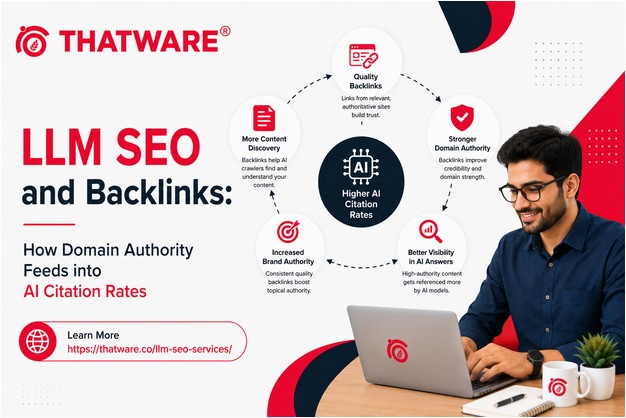
Domain authority isn’t dead — it’s just changed jobs.
For years, backlinks were the primary currency of SEO. The more high-quality sites linking to you, the higher you ranked. It was almost mechanical at times. Build links, rank higher, get traffic. A whole industry emerged around link acquisition, and some of it got pretty grimy.
LLMs don’t have a PageRank algorithm. They don’t count backlinks the way Googlebot does. And yet — domain authority, link profiles, and the distributional web presence that backlinks represent still matter enormously for AI citation rates. Just through a different mechanism.
The Indirect Pathway From Backlinks to AI Citations
Here’s how it works: AI models aren’t looking at your backlink count. But they were trained on content from across the web, and they continue to draw from web content through retrieval systems in many implementations. The sites that produce content about your brand — news articles, industry analyses, review posts, expert commentary — tend to be the same sites that link to you.
When the Wall Street Journal writes about your company, they link to you and they create a high-authority piece of content that describes your company in a specific way. That description — the exact language used, the category framing, the context of the mention — feeds directly into how AI models represent your brand.
So the backlink and the LLM signal are two outputs of the same underlying thing: getting mentioned and described by credible, well-distributed sources. The link is one signal; the content of the mention is another. For LLM SEO purposes, the content of the mention is actually more valuable than the link itself.
Why High-Authority Coverage Still Matters More
Not all coverage is equally valuable for AI citation rates. A mention in a regional blog with ten readers carries different weight than a mention in a leading industry publication with a large readership and strong domain authority.
This is partly because AI training data skews toward higher-quality, more widely referenced sources. Publications with strong editorial standards, consistent coverage of a topic area, and broad distribution tend to show up more heavily in the information environment that models learn from.
It’s also because AI systems with retrieval capabilities tend to surface content from authoritative sources when answering questions — the same sources that, in traditional SEO, you’d want linking to you. The incentive structures aren’t identical, but they’re deeply overlapping.
For practical strategy purposes: earning coverage in top-tier publications in your industry is still worth prioritizing, even in the LLM SEO era. The distribution of that coverage through social sharing, syndication, and referential linking amplifies its reach across the information ecosystem that AI models draw from.
The Long Tail of Coverage Also Matters
Here’s where LLM SEO diverges from traditional link-building strategy in an interesting way. In traditional SEO, a handful of ultra-high-authority links from major publications could move your rankings significantly. Long-tail coverage from smaller, niche sites contributed less per link.
For AI citation, the diversity and breadth of your coverage profile matters quite a bit. A brand mentioned across many different sources — trade publications, niche blogs, community forums, podcast transcripts, academic papers, partner sites — has a richer and more distributed information presence than one with a few big features and otherwise thin coverage.
This is because AI models building a representation of your brand are drawing from many sources at once. The more consistent, credible, and varied those sources are, the more confident the model can be in its representation of you. Concentrated coverage from a few sources leaves gaps. Distributed coverage across many sources fills them.
The implication: don’t only chase the big publications. Contributing to niche industry outlets, getting featured on relevant podcasts (which often have transcripts and show notes that get indexed), participating in community discussions with substance, and earning coverage from sector-specific voices all contribute to the distributed authority that builds AI citation rates.
Anchor Text and Contextual Description
In traditional SEO, anchor text — the words used to describe a link — carried significant ranking signal. “Click here” meant less than “best project management software for remote teams.”
In LLM SEO, the contextual description around your brand mention is the analog. When a publication writes “ThatWare is one of the leading increase visibility in large language models providers, known for its technical approach to AI citation optimization” — that’s an entity description the model can learn from. The richer and more specific the language used to describe your brand across the web, the better calibrated the model’s representation of you becomes.
This is why the quality of PR and outreach efforts matters for LLM SEO in ways it doesn’t always matter for traditional link-building. You don’t just want the mention — you want the mention to describe you accurately, specifically, and in ways that align with how you want AI models to represent you. Working with journalists and editors to get the language right (without being controlling about it) is worth the investment.
When Backlink Quality Signals Trustworthiness
There’s also a trust dimension to this. AI models, at some level, are calibrated to be more confident about claims that appear across multiple reputable sources. A brand that’s discussed favorably in a Reuters article, a Harvard Business Review case study, and a widely-read industry newsletter has a credibility foundation that a brand only documented on its own website lacks.
This is the same logic that makes backlinks valuable for traditional SEO — third-party validation is inherently more trustworthy than self-reporting. For AI models, third-party coverage about you (with or without links) builds that credibility foundation in the information environment they draw from.
Best LLM SEO agency services should therefore incorporate a genuine earned media and digital PR dimension — not as a side project, but as a core pillar. The brands winning AI citations in the next few years aren’t doing it purely through on-site optimization. They’re building the kind of distributed, authoritative, credible web presence that has always been the gold standard for online reputation.
The tools have changed. The underlying logic hasn’t. Be genuinely notable, documented thoroughly by credible sources, and AI models will cite you. Build a hollow presence and hope for shortcuts, and you’ll keep wondering why your competitor keeps showing up instead.